
Introduction
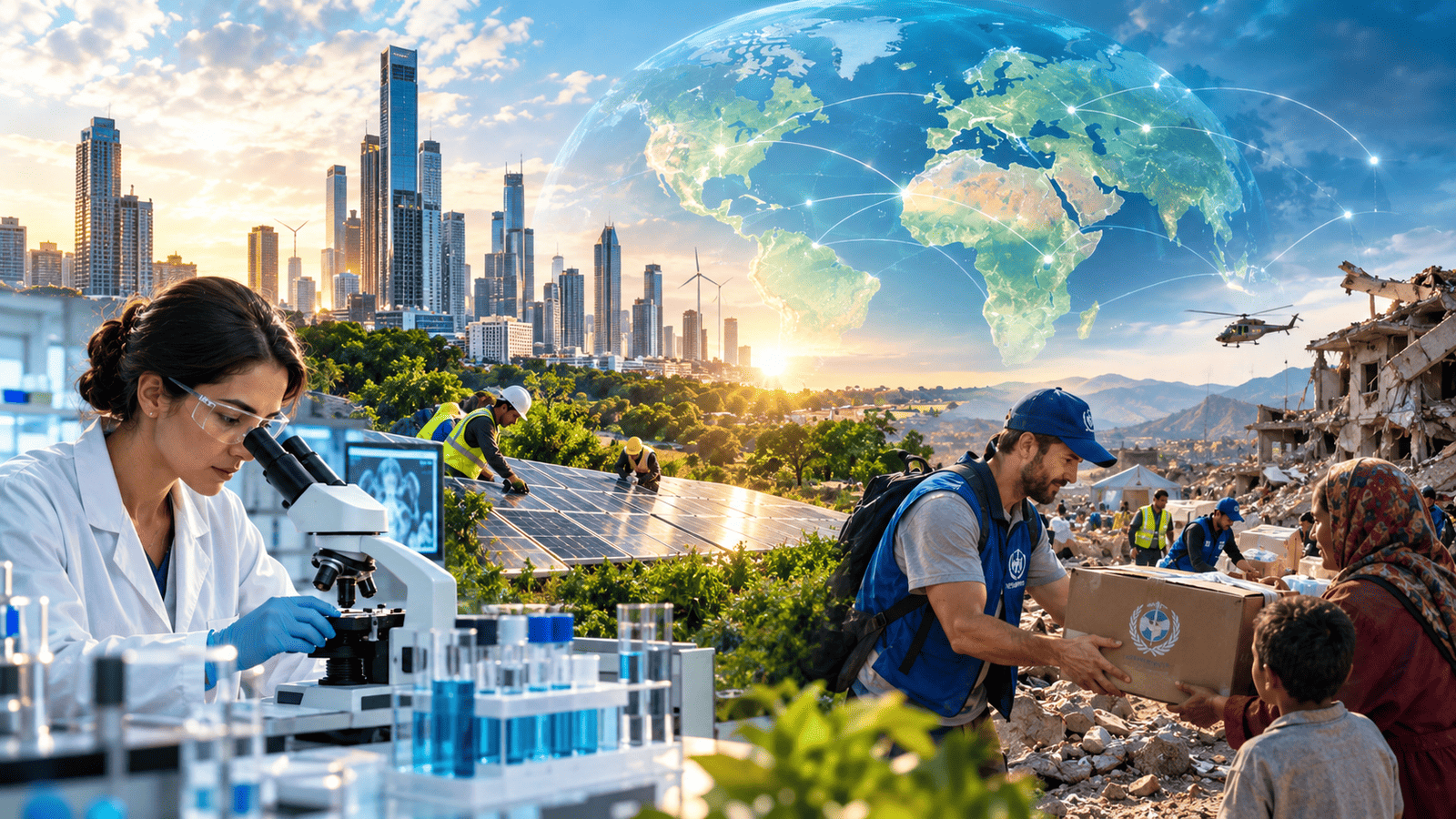
Countries may differ in their political systems, economic priorities, cultures and strategic interests, but the challenges confronting humanity increasingly cross national borders. Climate change does not stop at a frontier. Infectious diseases can spread between continents within days. Economic disruptions can move through international supply chains, while conflicts can generate displacement and humanitarian consequences far beyond the countries where fighting occurs.
This does not mean that the world has become politically united. On the contrary, geopolitical competition, armed conflicts, economic tensions and disagreements over national priorities remain significant. Yet these differences exist alongside a growing reality: many of the most consequential problems of the 21st century cannot be solved by individual countries acting alone.
That tension—between national interests and shared global risks—is at the heart of the modern international system.
Recent evidence illustrates the scale of the challenge. The World Meteorological Organization reports that 2015–2025 were the 11 hottest years on record, while 2025 was among the three warmest years ever recorded. The United Nations’ 2026 assessment of the Sustainable Development Goals likewise warns that progress remains uneven and insufficient, with conflict, climate change, slower economic growth, debt pressures and declining development assistance creating additional obstacles.
The lesson is not that differences between countries no longer matter. It is that shared vulnerabilities increasingly matter too.
A Connected World Creates Shared Risks
Globalization has created unprecedented connections between people, businesses and governments. Goods cross borders through complex supply chains; people travel more frequently; financial markets react to events in distant economies; and information can circulate worldwide within seconds.
These connections have generated enormous benefits, including economic opportunities, technological innovation and wider access to knowledge. But they also mean that local disruptions can acquire international consequences.
A conflict affecting a major trading region, for example, can disrupt transportation, food supplies or energy markets. A disease outbreak can become an international health emergency. Severe climate events can damage infrastructure, agriculture and economies, while their effects can be amplified by existing poverty and inequality.
This interconnectedness creates a paradox. Countries have strong reasons to protect their national interests, but their prosperity and security are increasingly influenced by developments beyond their borders.
Global cooperation is therefore not simply an idealistic concept. In many areas, it is a practical response to interdependence.
Climate Change : A Challenge No Country Can Solve Alone
Climate change is perhaps the clearest example of a problem that transcends national boundaries.
The atmosphere is shared, meaning that greenhouse-gas emissions released in one country contribute to a global process. At the same time, the effects of a changing climate can affect countries that have contributed relatively little to historical emissions.
The WMO’s State of the Global Climate 2025 found that 2015–2025 constituted the 11 warmest years in the instrumental record. It also reported continued ocean warming and increasingly consequential extreme weather events.
These developments have consequences for agriculture, water resources, public health, infrastructure and economic stability. They also demonstrate why purely national solutions have limitations.
Governments can reduce emissions through domestic policies, invest in renewable energy and strengthen climate resilience. However, the overall effectiveness of those efforts depends partly on what happens elsewhere.
International cooperation can help countries :
- coordinate emissions-reduction efforts;
- develop and share clean technologies;
- finance adaptation in vulnerable countries;
- improve climate monitoring and early-warning systems;
- protect ecosystems and biodiversity; and
- establish common standards for sustainable investment.
The challenge is particularly complex because countries have different levels of development, energy needs and historical contributions to greenhouse-gas emissions. Effective cooperation therefore requires not only ambition but also negotiation over fairness, financing and responsibility.
Global Health Shows Why Borders Cannot Stop Disease
Health emergencies provide another powerful example of shared vulnerability.
The COVID-19 pandemic demonstrated how quickly a health crisis can produce social and economic consequences across the world. It also exposed weaknesses in international preparedness and inequalities in access to vaccines, medicines and other medical resources.
In May 2025, WHO Member States adopted the world’s first Pandemic Agreement, designed to strengthen international cooperation on pandemic prevention, preparedness and response. The agreement addresses areas including surveillance, health-system resilience, research, production capacity, equitable access to medical products and international coordination.
The amended International Health Regulations also entered into force in September 2025. Among other changes, they introduced a new “pandemic emergency” alert level intended to strengthen coordinated international action when a health threat presents a risk of widespread international consequences.
These developments illustrate an important principle: international cooperation does not eliminate national sovereignty. Rather, countries can retain responsibility for their own health policies while establishing mechanisms to share information, coordinate responses and reduce risks that no government can contain independently.
The WHO’s 2025 Exercise Polaris offered a practical example. More than 15 countries and over 20 regional health agencies, networks and partners participated in a simulation designed to test international coordination during a hypothetical outbreak. More than 350 health emergency experts were connected through the exercise.
Preparedness, in other words, depends not only on what individual countries can do but also on whether they can work together when a crisis crosses borders.
Poverty and Inequality Are Global Concerns
Economic inequality is another area where national and international interests overlap.
According to the World Bank’s Poverty, Prosperity, and Planet Report 2024, almost 700 million people were living in extreme poverty under the report’s $2.15-a-day threshold, while global poverty reduction had slowed dramatically. The report also found that around 3.5 billion people were living below $6.85 a day, a threshold relevant to living standards in upper-middle-income economies.
Poverty is not simply a question of income. It affects access to education, healthcare, food, housing, infrastructure and economic opportunity.
Inequality can also make societies more vulnerable to shocks. When households have limited savings, weak social protection or poor access to essential services, a climate disaster, health emergency or economic downturn can have disproportionately severe consequences.
The international community therefore has an interest in supporting development that creates opportunities while strengthening resilience.
The United Nations’ 2026 Sustainable Development Goals report makes a similar point. It finds that the SDGs have produced substantial improvements in areas such as access to clean water, electricity, healthcare and digital connectivity, but progress remains too slow and uneven to meet many of the 2030 objectives without a significant acceleration of action.
Conflict and Displacement Reveal the Human Cost of Division
Armed conflict is one of the most visible manifestations of international division, but its consequences rarely remain confined to the battlefield.
War can destroy homes, infrastructure and livelihoods while creating refugee and internally displaced populations. It can also increase pressure on neighbouring countries and international humanitarian organizations.
UNHCR reported that 117.8 million people were forcibly displaced worldwide at the end of 2025. Although this represented a decline from the record 123.2 million recorded at the end of 2024, the scale remained enormous. UNHCR described the decline in 2025 as the first fall in global forced displacement in a decade.
The figures demonstrate both the persistence of conflict-related humanitarian crises and the possibility that conditions can improve when circumstances change.
Preventing conflict remains primarily a political and diplomatic responsibility. But humanitarian cooperation, refugee protection, peacebuilding and support for reconstruction can help reduce the consequences of conflict and create conditions for recovery.
The broader lesson is that security is increasingly interconnected. Instability in one region can affect migration, food security, international trade and political relations elsewhere.
Economic Interdependence Makes Cooperation Necessary
The global economy provides perhaps the most tangible evidence of mutual dependence.
Countries compete for investment, technology, markets and strategic influence, but they also depend on international trade and cross-border economic relationships. Modern production frequently involves components, raw materials, services and expertise from multiple countries.
That interdependence creates vulnerabilities. Trade restrictions, geopolitical tensions and supply-chain disruptions can increase costs and reduce economic efficiency.
The International Monetary Fund has warned that geopolitical fragmentation could weaken the benefits generated by decades of economic integration. At the same time, IMF research published in 2026 argues that even strategic rivals can benefit from trade cooperation, suggesting that geopolitical competition does not necessarily make economic cooperation impossible.
The challenge is therefore to find a balance between legitimate national-security concerns and the economic advantages of an open, predictable international system.
Cooperation does not require countries to abandon competition. It requires them to establish rules and mechanisms that make competition more stable and less damaging.
Technology Creates Both Common Opportunities and Common Risks
Digital technology has further blurred the boundaries between national and international affairs.
Artificial intelligence, telecommunications and digital services can accelerate scientific research, education and economic development. At the same time, cyber threats, misinformation, privacy concerns and unequal access to technology can affect societies across borders.
The speed at which digital information travels makes international coordination increasingly important. Governments must consider how emerging technologies affect not only domestic policy but also global security, economic competition and human rights.
Technology also offers an important opportunity for cooperation. Shared scientific research, open data, early-warning systems and international standards can help countries address challenges more effectively.
The key question is not whether technology will connect the world—it already has—but whether institutions can keep pace with the changes it creates.
What Global Cooperation Should Look Like
International cooperation is sometimes presented as if it means governments must agree on everything. That is unrealistic.
Countries have legitimate differences in values, economic structures, strategic interests and domestic priorities. Effective cooperation therefore does not require uniformity.
Instead, practical global cooperation can focus on areas of common interest.
1. Share reliable information
International crises become more difficult to manage when governments lack accurate or timely information. Transparent data-sharing can improve decision-making, particularly in public health, climate monitoring and disaster response.
2. Strengthen international institutions
Organizations such as the United Nations, WHO and other multilateral institutions provide mechanisms for countries to negotiate, coordinate and respond to shared problems. Their effectiveness depends on political support, adequate resources and the willingness of governments to implement commitments.
3. Invest in resilience
Prevention is often less costly than responding to a crisis after it has occurred. Investments in healthcare, climate adaptation, infrastructure, education and social protection can reduce vulnerability.
4. Make cooperation more equitable
International agreements are more likely to succeed when countries believe that responsibilities and benefits are distributed fairly. Developing countries frequently face constraints in financing, technology and institutional capacity that need to be addressed.
5. Protect space for dialogue
Even when governments disagree, diplomatic channels remain valuable. Communication can reduce misunderstandings, establish common ground and create opportunities for negotiated solutions.
Key Facts and Findings
| Challenge | Recent evidence | Why cooperation matters |
|---|---|---|
| Climate change | 2015–2025 were the 11 warmest years on record | Emissions and climate impacts cross borders |
| Global health | WHO Member States adopted a Pandemic Agreement in 2025 | Disease surveillance and preparedness require coordination |
| Forced displacement | 117.8 million people were forcibly displaced at the end of 2025 | Conflict creates regional and international humanitarian consequences |
| Poverty | Nearly 700 million people were living in extreme poverty under the World Bank’s $2.15-a-day threshold in its 2024 assessment | Development, finance, trade and resilience are interconnected |
| Sustainable development | The UN’s 2026 report says progress is real but insufficient across many SDG targets | Meeting global development goals requires sustained investment and cooperation |
| Trade | IMF analysis highlights the risks of excessive economic fragmentation | Stable trade relationships can benefit countries even amid geopolitical competition |
Sources: WMO, WHO, UNHCR, World Bank, United Nations and IMF.
The Difference Between Unity and Cooperation
It is important not to confuse global cooperation with global unity.
The international community remains divided on many major political and security questions. Governments continue to compete for influence, resources and strategic advantage. International institutions themselves face political disagreements and financial constraints.
Yet cooperation can exist even when consensus is incomplete.
Countries do not need identical interests to cooperate on disease surveillance. They do not need identical political systems to exchange weather data. They do not need to agree on every geopolitical question to negotiate trade rules, coordinate disaster responses or reduce the risks posed by climate change.
This distinction is crucial.
The world is not necessarily becoming one political community. It is becoming a more interconnected community of risks.
A Shared Future Requires Shared Responsibility
The greatest challenge of international cooperation may be translating recognition of shared problems into sustained action.
Governments must balance immediate domestic pressures with long-term global interests. International agreements must be accompanied by implementation. Financial commitments must reach the communities that need them. Scientific evidence must inform policy, while public trust must be protected.
The United Nations’ latest assessment of the Sustainable Development Goals offers both a warning and a reason for optimism. Progress has improved the lives of billions, but the pace is insufficient and the remaining challenges are substantial. The organization identifies stronger international cooperation, investment, technology access, climate action and renewed commitments to peace as important elements of accelerating progress.
The central idea is straightforward: shared problems require mechanisms for shared action.
Conclusion : Our Differences Matter, but So Do Our Common Interests
The modern world is defined by both diversity and interdependence. Nations have different histories, cultures, political systems and interests. Those differences will not disappear—and they should not necessarily disappear.
But climate change, pandemics, poverty, displacement, economic instability and technological risks demonstrate that national borders cannot completely separate one society from another.
Global cooperation is therefore not about creating a world without disagreement. It is about building enough common ground to manage problems that affect everyone.
The evidence is clear: some of the most important challenges of our time are transnational by nature. Climate systems are shared. Infectious diseases travel. Markets are connected. Environmental disasters cross borders. Human displacement creates regional consequences. Technology spreads globally.
The practical response is neither isolation nor the expectation of perfect international consensus. It is cooperation based on evidence, mutual responsibility, transparency and realistic common interests.
In an increasingly interconnected world, the question is not whether countries have differences. They do. The more important question is whether they can recognize that, alongside those differences, they also share a future.
That may be the strongest reason for global cooperation: the world does not have to agree on everything to act together on what matters most.
Leave a Reply